
Your General Ledger Is Lying to You. You Just Don't Know It Yet.

Updated: Sep 24
Do you trust the numbers in your financial reports? No? Somewhat? Yes? It doesn't matter. By the time you're reading them, they're already out of date.
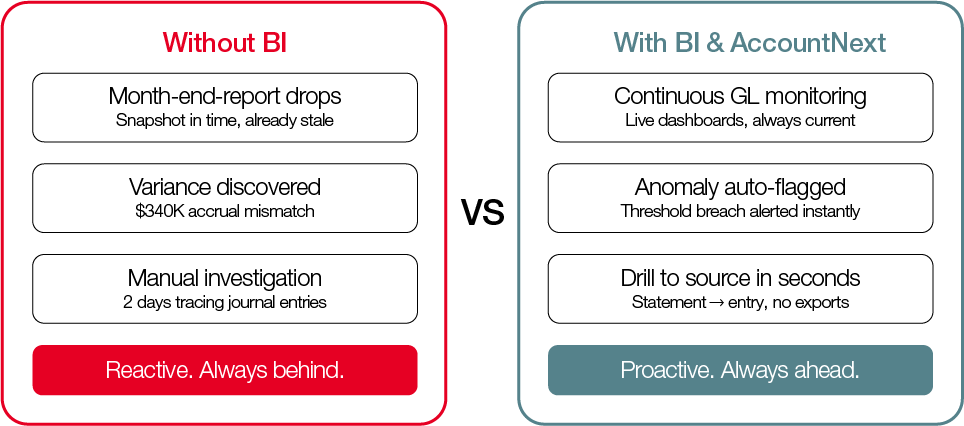
You're eight days into close. Accrued liabilities are up $340,000 with no explanation. Two days later, you find a duplicate vendor accrual from a subsidiary.
The mistake took minutes to make. It cost days to find.
Sound familiar?
The Real Problem Isn't Your Team. It's Your Visibility.
Most finance teams aren't slow. They're blind. They're working with a general ledger that only tells the full story after the fact, through static reports, manual exports, and spreadsheets that are already out of date by the time they're reviewed.
The result? Controllers chasing variances instead of preventing them. CFOs walking into board meetings without instant answers. Audit prep that turns into an all-hands scramble.
This isn't a people problem. It's a tooling problem.
Where Business Intelligence Changes the Game
Traditional finance tools record what happened. BI tells you what it means and what's likely to happen next.
By layering analytics on top of your GL data, BI surfaces patterns that static reports never could: which accounts are trending in the wrong direction, where costs are creeping before they spike, and how actuals are tracking against forecast in real time. Instead of reacting to numbers at month-end, you're monitoring them continuously and making decisions with current data, not last period's snapshot.
For Controllers, that means fewer surprises during close. For CFOs, it means walking into every conversation already knowing the answer.
What Real GL Visibility Looks Like
AccountNext turns your general ledger from a black box into a live financial intelligence system. Here's what that means in practice:
01
See anomalies before they become variances.
Automated thresholds flag accounts the moment they move outside expected ranges, not at month-end when it's too late.
02
Kill the spreadsheet maze.
Accrual roll-forwards, Income and Balance sheet schedules generated automatically from your ledger data, reports always current, no manual maintenance.
03
Answer any question in seconds.
Drill from financial statement to account balance to originating journal entry without leaving the platform. No more "let me get back to you on that."
04
Close faster, audit easier.
With exceptions caught early and full transaction traceability built in, close cycles shrink and audit support becomes a matter of clicks, not days.
The Bottom Line
Finance leaders aren't paid to explain the past. They're paid to see what's coming and act on it.
If your general ledger still makes you work backwards to find answers, that's not an accounting problem, it's a competitive disadvantage.
Comments